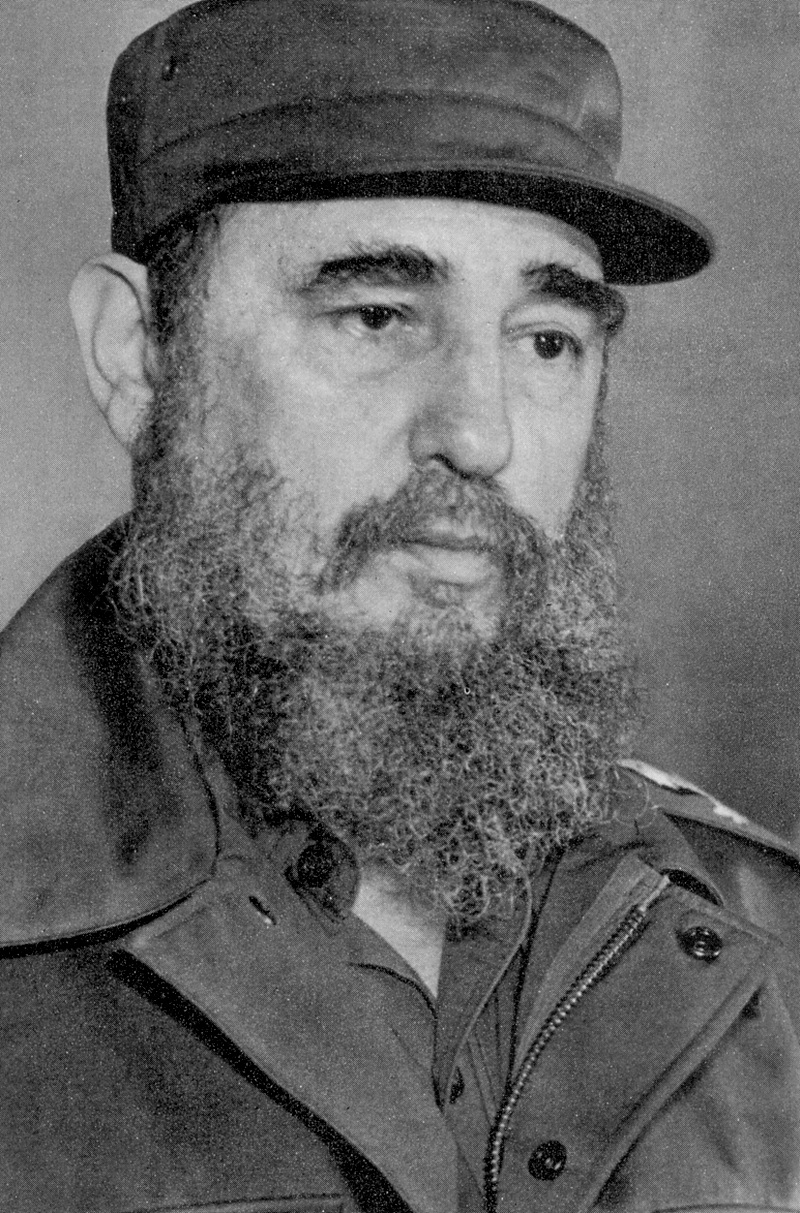
Political leader of Cuba
Born on 13 August 1926
Born in Biran, Cuba
Fidel Castro is a revolutionary figure and former Prime Minister of Cuba who served the country from 1959 to 1976 and gained a reputation of an anti- capitalist who openly refuted the American dominance in Asian countries. He was also the 22nd president of the country, a position he took in 1976 and held until 2008, when he resigned and formally transferred all his duties and powers to his brother, vice -president Raul Castro. As a major political, Fidel drew attention for his highly critical views on Capitalists countries including the United States, whose political and corporate influence in Cuba had increased with time. In 1965, he became the first secretary of the communist party of Cuba and embarked on a mission of transforming Cuba into a one-party socialist republic. As a head of Cuba, Castro led the country for nearly five decades and still remains active till this day.
Childhood
Fidel Castro was born on August 13, 1926 in Biran, near Mayari, Cuba. His father Angel Castro y Argiz, originally from Spain, was relatively wealthy and owned a sugarcane plantation. His mother Lina Ruz Gonzalez had been a maid to Angel's first wife. He grew up in wealthy circumstances amid poverty. His original name was Fidel Alejandro Castro Ruz.
After completing his elementary education at the private Catholic School, Fidel went to El Colegio de Belen, a Jesuit school in Havana in 1945. Fidel was an intellectually gifted student with an amazing memory-power. Fidel was, in fact, more interested in sports than in academics and while at Belen, Castro pitched on the school's baseball team. A peasant rebellion in Oriente during Castro's formative years is thought to have influenced his political leanings.
Student Politics
In 1945 Castro entered law school at the University of Havana, where student activism, violence, and gang fights were common. He became immediately embroiled in the political culture at the University and associated with one of the gangs, the “Union Insurreccional Revolucionaria”. The police even suspected him of the murder of a rival student leader and other violent actions but could not corroborate anything. Despite his reputation and public speaking ability Fidel never became a well-known student leader and lost several student elections.
General Election
In 1947, Castro joined the newly formed Partido Ortodoxo formed by Eduardo Chibas. The Partido Ortodoxo publicly exposed corruption and aimed at establishing Cuban economic independence and freedom from the United States. Chibas was the Presidential candidate for the Party and however lost the election. In 1951, Chibas died after he shot himself in the stomach during a radio broadcast.Following Chiba’s death, Fidel campaigned for a seat in the Cuban Congress and the Party was expected to win the election. But, things changed suddenly when Fulgencio Batista, in a coup seized control of the Cuban government in order to prevent the rise of the Orthodoxos. Under Batista, thousands of political opponents were murdered and the people were held under massive oppression.
Batista established himself as de facto leader and was supported by elements of Cuban society and powerful Cuban agencies. Castro broke away from the Partido Ortodoxo to initiate legal arguments and formally charged Batista with violating the constitution. His petition was denied by the Court of Constitutional Guarantees and he was not allowed even a single hearing. This experience convinced Castro that revolution was the only way to depose Batista and coming to power. Castro married Mirta Diaz Balart, a student from a wealthy Cuban family.
Revolution
In 1953, Castro abandoned his law practice and led an armed group of fighters to overthrow Batista. On the 26th of July, 1953, they attacked Moncada Barracks, Batista's largest garrison outside Santiago de Cuba. In the battle, over sixty revolutionaries were killed and rests, including Fidel Castro, were sent to prison. Though the depose-attempt landed Castro in prison but it also fetched him popularity across Cuba.
After being released in 1955, Castro went to Mexico and met Argentine revolutionary Ernesto "Che" Guevara to prepare for second attempt to topple Batista. Since regular contacts with KGB (Soviet Intelligence Agency) had not resulted in the hope for weapon supply, Castro and Guevara visited the United States of America to gather personnel and funds from Cubans living in the US.
After building up a stock of guns and ammunition, Castro, Che Guevara, Juan Almeida along with eighty other rebels set out from Tuxpan, Veracruz on November 26, 1956, for the purpose of starting a rebellion in Cuba. The group was trained under a veteran of Spanish Civil War and became known as the “July 26 Movement” (the date that Castro had attacked the Moncada barracks). Their plan was to set up their base in the Sierra Maestra mountains. On the way to the mountains they were attacked by government troops. By the time they reached the Sierra Maestra there were only sixteen men left with twelve weapons between them. For the next few months Castro's guerrilla army raided isolated army garrisons and were gradually able to build-up their stock of weapons.
The 26th of July Movement waged a guerrilla war against the Batista government and when the guerrillas took control of territory they redistributed the land amongst the peasants. In return, the peasants helped the guerrillas against Batista's soldiers. Many resistant groups were formed in the towns and rural regions of Cuba. In some cases the peasants also joined Castro's army. In an effort to find out information about Castro's army people were pulled in for questioning. Many innocent people were tortured. Suspects, including children, were publicly executed and then left hanging in the streets for several days as a warning to others who were considering joining Castro. The behavior of Batista's forces increased support for the guerrillas.
In an attempt to crush the fighters of Castro and other resistant outfits, Batista launched, Operation Verano in 1958. Castro's guerrilla forces scored a series of victories, largely aided by Batista's uncommitted and poorly trained army When Operation Verano ended, Castro ordered three columns commanded by Guevara, Jaime Vega and Camilo Cienfuegos to invade central Cuba where they enjoyed the strong support of rebellious elements. In January 1959, Batista lost the battle at Santa Clara and fled to the Dominican Republic. The junta (military rule) selected Dr. Carlos Piedra, one of the oldest judges of the Supreme Court, as provisional President of Cuba but Castro refused to accept the selection. The workers came out on strike and the military were forced to accept the people's desire for change.
Castro - The Leader
On January 8, 1959, Castro marched into Havana victoriously as Cuba’s new and popular leader. On January 5, on Castro’s demand, Dr. Urrutia, former judge of the Urgency Court of Santiago de Cuba, was installed as the Provisional President and Law professor Jose Miro Cardona as Prime Minister. Castro assumed the post of Commander-in-Chief of the Armed Forces on January 8. Following the sudden resignation of Jose Miro on February 16, 1959, Castro was sworn in as the new Prime Minister of Cuba.
The United States quickly recognized the new Cuban government, but tensions arose as Fidel Castro set about far-reaching reforms. In his first hundred days in office Castro's passed several new laws including
* Rents were cut by up to 50 per cent for low wage earners
* Property owned by Batista and his ministers was confiscated;
* The telephone company was nationalized and the rates were reduced by 50 per cent;
* Land, including his own portion was redistributed amongst the peasants
* Abolished separate facilities like swimming pools, beaches, hotels, cemeteries for blacks and whites.
These pro-peasants and pro-worker reforms led to the end of U.S. economic dominance. Moreover, Castro also began to establish closer ties with the Soviet Union. In 1960, a variety of pacts were signed between Castro and Soviet Premier Nikita Khrushchev, allowing Cuba to receive large amounts of economic and military aid from the USSR. Consequently, on January 3, 1961, Washington broke off diplomatic ties with Cuba.
On April 16, 1961, he formally declared Cuba a socialist state. The very next day, around 1,400 members Cuban exiles, trained by the Central Intelligence Agency, invaded at the Bay of Pigs. The Cuban armed forces repelled the invaders, killing many and capturing a thousand.
Operation Mongoose
In March 1960, Eisenhower approved a CIA plan to overthrow Castro. The plan involved a budget of $13 million to train "a paramilitary force outside Cuba for guerrilla action." The strategy was organized by Richard Bissell and Richard Helms. An estimated 400 CIA officers were employed full-time to carry out what became known as Operation Mongoose. Edward Lansdale became project leader whereas William Harvey became head of what became known as Task Force W. The JM WAVE station served as operational headquarters for “Operation Mongoose”.
Fidel Castro once said, “"If surviving assassination attempts were an Olympic event, I would win the gold medal." The group or unit responsible for Castro’s protection has revealed that there were 638 attempts made by the CIA to kill Castro, but every time he survived.
In a survey carried out by a private firm found that 90 per cent of the Cuban population, supported Fidel Castro and policies. The revelation assisted Castro in tightening his grip over Cuba and he took started enjoying all the powers of the government. He was all-in-all of Cuba. Castro put a ban on the existence of political parties and announced that it would destroy the national unity and integrity.
Castro was also becoming harsh towards people, especially intellectuals and political thinkers who argued his policies and actions. He often reshuffled his ministries and inducted the young soldiers who were loyal to him during the guerilla war against Batista. Castro continued to serve as the “Head of the state” for almost five decades.
Retirement
While suffering from number of severe illnesses, on July 31, 2006, Castro delegated all his powers to his brother Raul Castro. The powers included were that of President of the Council of state, President of the Council of Ministers, First Secretary of the Cuban Communist Party and the post of commander in chief of the armed forces. Announcing his retirement from official public life, Castro on February 18, 2008, said that he would not accept the positions of president and commander in chief. On February 24, 2008, the National Assembly of People's Power unanimously chose his brother, Raul Castro, as Fidel's successor as President of Cuba.
Timeline
1926, August 13: Birth of Fidel Castro
1945: Admission in El Colegio De Belen, a Jesuit school in Havana
1947: Castro joined the Partido Ortodoxo formed by Eduardo Chibas.
1951: Chibas shot himself and died
1953: Castro led fighters attacked Moncada Barrack
1953: Castro arrested and sent to prison
1955: Released from prison and Castro visited Mexico to meet Che Guevara
1956: Guerilla War against Batista government in Cuba
1958: Batista launched Operation Verano
1959: Batista lost and flee Dominican Republic
1959, January 8: Fidel marched victoriously to Havana
1959, February 16: Sworn in as Prime Minister
1960: Closer to Soviet Union, signed several pacts
1961, January 3: US broke off all ties
1961, April 16: Cuba declared socialist state
2008, February 18: Formally delegated powers to brother Raul Castro
From : www.thefamouspeople.com